Valorant Champions Shanghai, what Day 2 of the group stage revealed
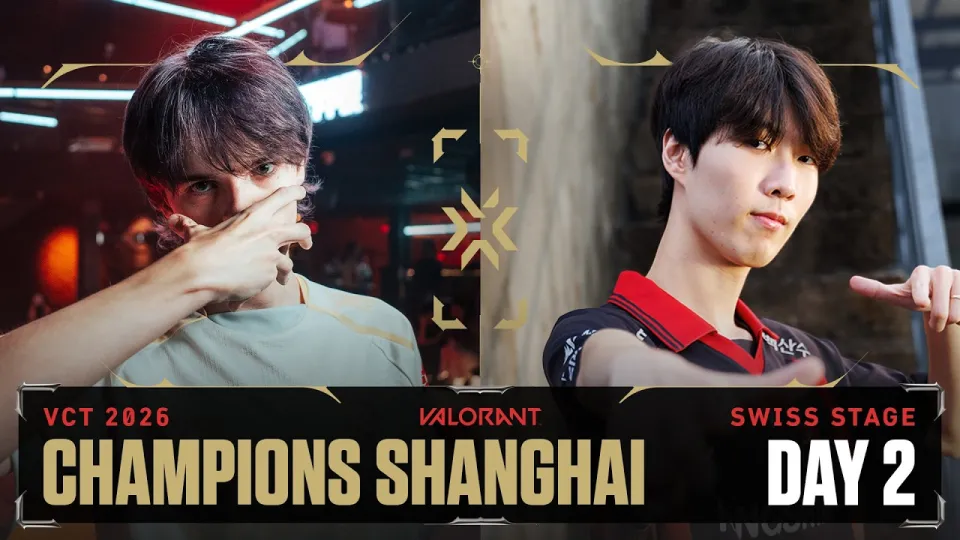
Video: VALORANT Champions Shanghai — Group Stage — Day 2
Want articles like this for your own video to promote it on YouTube and Google? Order them through the Telegram bot @sat_sit_bot. It writes articles around your video, embeds the video and publishes them on popular niche websites (no ads). Free trial — 50 articles.
· based on the channel VALORANT Champions Tour
Key takeaways
- Valorant Champions Shanghai runs September 24 to October 18 and decides the 2026 world champion.
- Sixteen teams qualified from four regions: Americas, China (CN), EMEA and Pacific.
- Day 2 of the group stage was broadcast by the VALORANT Champions Tour channel as a full VOD.
- Group stage uses best-of-three series; playoffs move to best-of-five, including a double-elimination bracket.
- The event's partners include AWS, Coinbase, HyperX, Mastercard, OnePlus, Red Bull, Secretlab and Verizon.
Valorant Champions Shanghai is the 2026 world championship of the VALORANT Champions Tour, and its group stage decides which of the 16 qualified teams from the Americas, China, EMEA and Pacific advance toward the trophy. Day 2 of that group stage, published by the VALORANT Champions Tour channel on September 25, 2026, is a full-length VOD of the second day of play — and the fastest way to catch up on results, upsets and storylines is to follow the official account at VALORANT Esports on X, where brackets, schedules and announcements land first.
What the Valorant Champions Shanghai group stage actually is
The group stage is the first phase of the tournament and the filter that turns a 16-team field into a playoff bracket. Teams are split into groups, each team plays the others in its group in a round-robin, and the top finishers advance. Series in this phase are best-of-three: two maps win the series, so a team can win map one, lose map two and still close it out on the decider. That structure is why group-stage days can look like a "speedrun" — a dominant roster can close two maps in well under an hour and a half of broadcast time, while a scrappy 2-1 drags the day out.
Because the format rewards consistency over a single hot map, the group stage is where preparation shows. Teams that arrive with a deep map pool can ban away an opponent's comfort pick and force them onto something they have not practiced. Teams that arrive with two strong maps and a weak third often survive the group stage and then get exposed in the playoffs, where the series get longer.
Format and schedule at a glance
- Dates: the event runs from September 24 to October 18, per the official broadcast description.
- Field: 16 teams, drawn from four regions — Americas, CN, EMEA and Pacific.
- Group stage: round-robin groups, best-of-three series.
- Playoffs: a bracket that concludes with the grand final, where the 2026 world champion is crowned.
- Broadcast: matches stream on the official VALORANT channels, including Twitch and YouTube, with the VOD archive on the VALORANT Champions Tour channel.
The Day 2 VOD is a complete broadcast rather than a highlight reel, which means it includes analyst desk segments, player interviews with translation, and the full map-by-map action. That is also why viewer comments about the day focus as much on pacing and production as on the games themselves.
The regions, the slots and why the debate keeps coming back
China holds four slots at international VALORANT events, and that allocation is the single most argued-about topic in the comment section of the Day 2 broadcast. The criticism has two versions: that four slots is too many for a region whose teams have not yet converted them into deep playoff runs, and that CN should be merged into Pacific so the strongest Pacific rosters get the international exposure instead.
The counter-argument is structural rather than sentimental. China is one of the largest player bases in the world, it has its own domestic league ecosystem, and it was the first market to receive VALORANT Mobile. Riot Games has historically granted slots to regions that sustain their own competitive infrastructure, not just to regions that win trophies, because the slots fund the league below them. A region that never gets international reps never develops the practice culture needed to win them.
What the Day 2 discussion really shows is a mismatch of expectations: viewers judge CN slots by international results, while the slots exist to build the domestic scene. Both things can be true at once, and the argument will only settle when a CN team makes a deep run at a Champions event.
Reading a group-stage day like an analyst
A full broadcast day is long, and the useful information is not evenly distributed. A practical way to watch a VOD like Day 2:
- Check the series score first. A 2-0 tells you one team's preparation worked; a 2-1 tells you the losing side found something on their map pick.
- Watch the pistol rounds. They set the economy for the next two or three rounds, and in best-of-three group play a single pistol swing often decides a map.
- Track the map veto. If a team's best map keeps getting banned, their group run is being managed by opponents, not by themselves.
- Note the clutch rounds. Individual 1vX conversions are the clearest signal of which players are comfortable on the Champions stage.
- Ignore the desk narrative until the end. Analyst predictions age badly in a 16-team field; the scoreboard does not.
Group-stage days also produce the season's most extreme scorelines. When one team's read on the meta is a patch ahead, the series can look one-sided enough that viewers describe it as a mismatch of ranks rather than a match of professionals. That is not a flaw in the format — it is what a wide-open field looks like before the bracket narrows.
Production, spoilers and the small irritations
Two production complaints dominate the Day 2 comments. The first is spoilers: thumbnails, titles and even the length of a VOD can hint at results, which is why community members post spoiler-blocking timestamps for people watching later. The second is interview translation — answers delivered in a few seconds can take noticeably longer once translated on air, which stretches the desk segments.
Neither issue changes the competitive outcome, but both shape how the broadcast is consumed. For viewers watching on delay, the practical approach is to open the VOD, avoid the comments, and use the chapter markers rather than scrubbing through the timeline.
Useful links
- Official VALORANT Esports updates: https://x.com/valorantesports
- Facebook: https://www.facebook.com/ValorantEsports/
- Instagram: https://www.instagram.com/valorantesports/
- TikTok: https://www.tiktok.com/@valorantesports
- Twitch: https://www.twitch.tv/valorant
The bigger picture for Valorant esports
Day 2 of the Shanghai group stage matters less as a set of results and more as a snapshot of where the competitive scene stands. The broadcast description frames the event as the moment a new generation of challengers meets the established names, and after two Masters titles going to new champions earlier in the season, the field at Champions is genuinely open. Sixteen teams across four regions, a best-of-three group stage that punishes shallow map pools, and a playoff bracket that rewards depth — that combination is what makes the tournament the hardest trophy of the year to win. For anyone following the season, the Day 2 VOD is a compact look at the form of the field before the bracket cuts it in half. The VALORANT Champions Tour channel is the source of the full broadcast, and the official X account at VALORANT Esports on X is where the schedule, results and bracket updates are published as the event moves toward October 18.
Questions & answers
How does the Valorant Champions Shanghai group stage work?
Sixteen teams from the Americas, China, EMEA and Pacific are placed into groups and play round-robin series. Group-stage series are best-of-three, and the teams that finish highest in each group advance to the playoff bracket, which decides the 2026 world champion. The event runs from September 24 to October 18.
Why does China get four slots at international Valorant events?
China receives four slots because it is one of the largest player bases and has its own domestic league ecosystem, and it was the first market to get VALORANT Mobile. Slots are allocated to regions that sustain competitive infrastructure, not only to regions with the best international results, which is why the allocation is debated every season.
Why do some group-stage matches look so one-sided?
In a 16-team field, the gap between a team with a deep, well-prepared map pool and a team with two comfortable maps can be large. A best-of-three lets the stronger roster close quickly on its own map picks, which produces scorelines that look lopsided even between professional teams.
How can I watch the Day 2 broadcast without spoilers?
Open the VOD directly from the VALORANT Champions Tour channel and avoid the comment section, since thumbnails and titles can hint at results. Community members often post spoiler-blocking timestamps for delayed viewers, and using the video chapters is faster than scrubbing the timeline manually.
Source: VALORANT Champions Shanghai — Group Stage — Day 2 · Markdown version